Two documents, 376 pages between them. Both are scans of paper originals, so neither is searchable as text yet. Both can be downloaded in full.
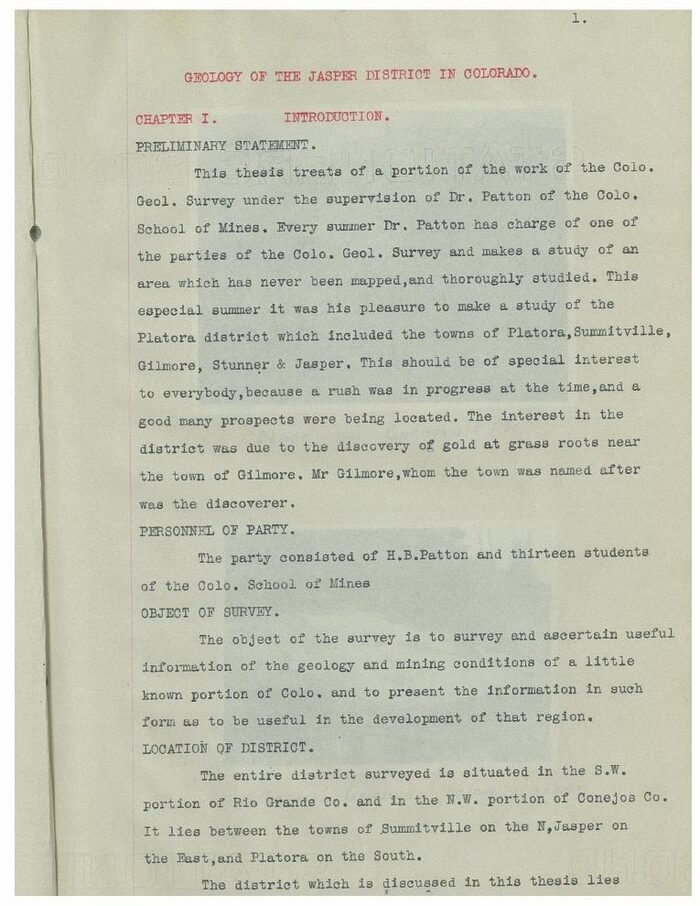
Geology of the Jasper District in Colorado
A graduation thesis written from the field work of a Colorado Geological Survey party under Dr. Horace B. Patton of the School of Mines. Patton took charge of a party each summer to study an area that had never been mapped. This one covered the Platora district, taking in Platora, Summitville, Gilmore, Stunner and Jasper.
The author notes the work should be of special interest "because a rush was in progress at the time, and a good many prospects were being located," the interest driven by the discovery of gold at grass roots near the town of Gilmore. It is a firsthand account of a gold rush at Jasper, written while the rush was happening.
He also records that the Denver and Rio Grande Railroad were contemplating building a line into Jasper, and describes a natural falls of about seventy five feet on Wightman’s Fork near where it meets the Alamosa.
- Contents
- Preliminary statement, personnel of party, method of survey, location and history of the district, topography, drainage, geology, mineralogy, ore deposits, mines and mills, and the Perry Mine
- Pages
- 30, including six mounted photographs
- Party
- Dr. H. B. Patton and thirteen students
- Acknowledges
- Dr. Patton, G. M. Hook, F. S. Watrous who held claims in the district, and L. F. Clark
- Provenance
- Library of the Colorado School of Mines, Golden, accession 17165
- Date
- Not yet established. The survey programme it belongs to produced Colorado Geological Survey Bulletin 13 in 1917
The Photographs
Six photographs are mounted through the thesis, each captioned by hand. They are among the oldest surviving photographs of Jasper. The captions are reproduced here exactly as written, including the period spelling of the town as Jaspar.
Bockhaus and Stein: From Germany To The San Luis Valley
A family history written by Virgil Bockhaus, tracing the Bockhaus and Backhaus lines from Germany to the San Luis Valley. In his own introduction he sets out to write down "a few things about Dad and Mother and their life in the San Luis Valley and their involvement with the Alamosa River area."
His parents were Louis and Emma Bockhaus of Monte Vista, and Emma’s family name was Stein, which is where the title comes from. The family ran the lumber business, driving lumber trucks and working the mills, which is very likely what the Alamosa River involvement refers to.
The route he traces runs from Germany, arriving in New York around 1865 or 1866 through Castle Garden rather than Ellis Island, then northeast Iowa, northwest Iowa, South Dakota and finally the San Luis Valley. He is candid throughout about conflicting dates and about having spent time searching the wrong surname. The book reproduces primary documents alongside the narrative, including an 1887 United States Land Office homestead proof filed at Yankton in Dakota Territory.
- Author
- Virgil William Bockhaus, 26 April 1929 to 26 February 2012. Obituary in The Daily Sentinel, Grand Junction, 29 February 2012
- Written
- After October 1998
- Research
- Years of travel with his wife Mavis. He was a past member of the Iowa Genealogical Society
Photographs of the Town
Two more photographs of Jasper, from outside the thesis. Neither is precisely dated and the second is not firmly identified.